Conroe was the fastest-growing large city in the United States between 2015 and 2016, according to the U.S. Census Bureau, and growth never really slowed down after that. The city has more than doubled in population since 2010, passing 114,000 residents by 2024, while Montgomery County is now approaching 800,000 people and adding roughly four percent more every year. Roads built for a much smaller city are carrying a population that grew faster than the infrastructure meant to support it, and the result is active construction on nearly every major corridor in town at any given time.
We handle a steady stream of motor vehicle accidents tied directly to this growth. Drivers caught off guard by a lane shift that wasn't there the week before. Rear-end collisions where traffic backs up behind a flagger with no warning. Pedestrians and cyclists navigating routes that were never designed to carry the volume they handle today.
The Types of Construction Projects Reshaping Conroe's Roads
Rapid growth tends to bring the same handful of infrastructure projects, and each type creates its own version of risk for drivers.
- Road widening projects, converting a two-lane road into four lanes with a center turn lane, are common wherever new subdivisions and retail centers spring up. These typically run in phases over a year or more, with lane configurations shifting more than once before the work is finished.
- Utility relocation often comes first, since water, sewer, and gas lines frequently have to move before a road can actually be widened. This stage can close a lane or shoulder for weeks with little visible progress, which tends to make drivers underestimate how long a restriction is going to last.
- Bridge and drainage work, including culvert replacements and new crossings over creeks or waterways, often requires a detour or a single lane controlled by a temporary signal or a flagger, conditions that are especially prone to rear-end collisions.
- New signalized intersections and roundabouts replace older intersections once traffic volume outgrows what a stop sign or a basic signal can handle safely. The transition period, before regular commuters learn the new configuration, is when confusion-related crashes are most common.
- Highway interchange and connector work, such as new flyovers or added frontage road lanes, tends to run the longest and carries the highest risk, since the work continues alongside traffic still moving at highway speed.
Common Ways Construction Zones Lead to Crashes
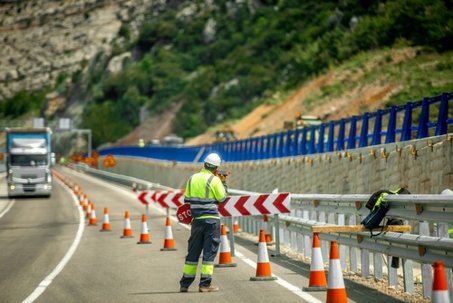
A handful of scenarios account for most of the crashes we see connected to active work zones, regardless of the type of project underway:
- Lane shifts and merges that catch drivers off guard, especially on a corridor that has changed configuration more than once over the life of a project
- Sudden backups behind a flagger or a lane closure, leading to rear-end collisions when a following driver doesn't have enough time or space to react
- Reduced visibility at night or in bad weather, when temporary lighting, barrels, or signage have not been properly maintained
- Workers or equipment operating close to active traffic lanes, particularly during shift changes or when work runs past its scheduled hours
- Uneven pavement, missing lane markings, or leftover debris between phases of a project, before final striping and signage are in place
Who Can Be Held Liable When a Construction Zone Contributes to a Crash
Fault in a construction zone crash rarely rests with just one party.
- A negligent driver is usually the most direct source of liability. Speeding through a work zone, following too closely, or failing to slow down for a flagger remains the driver's responsibility regardless of what is happening around them.
- A contractor managing the site can also share liability if its traffic control plan was not followed, if signage was missing or confusing, or if barriers were placed in a way that created a hazard rather than preventing one. Large road projects often involve subcontractors handling specific pieces of the work, such as signage placement or flagging services, and any one of them can end up sharing responsibility if their portion of the job contributed to the crash. Private contractors do not share the government's sovereign immunity, and most carry commercial general liability insurance specifically for highway and roadway work.
- A government entity, such as TxDOT, the City of Conroe, or Montgomery County, can share liability as well, but claims against a public agency work differently than claims against a driver or a contractor. The Texas Tort Claims Act waives sovereign immunity for certain negligence and premise defect claims, though discretionary decisions like how a project was designed generally remain immune. Claims against a government entity require written notice, which must be done within a specific time period depending on the type of governmental entity. Also, if the Defendant is a city, thendamages are capped at $250,000 per person and $500,000 per occurrence. If the Defendant is a county or school district, then damages are capped at $100,000.
What to Do If a Construction Zone Contributed to Your Crash
Document the work zone itself, not just the vehicles involved. When it is safe to do so, photograph the signage, barrels, lane markings, and lighting exactly as they appeared, since a work zone can look entirely different by the time an investigation catches up to it. Find out who was managing the site at the time. That detail determines whether a private contractor, a government entity, or both are part of the claim, and it affects how quickly you need to act to protect it. A contractor's approved traffic control plan and daily work logs can also show whether the zone matched what was supposed to be in place on the day of the crash, and that comparison is often where a case is won or lost.
Montgomery County's growth is not slowing down, and neither is the number of active work zones across Conroe, Magnolia, Cleveland, Montgomery, and Willis. If one of them contributed to your crash, our veteran-owned firm is based in downtown Conroe and ready to sort out who is actually responsible. Patrick Scott, our managing attorney, is Board Certified in Personal Injury Trial Law by the Texas Board of Legal Specialization.
For a FREE case review, call (936) 243-4299 or contact us online.